The restoration of the keeps
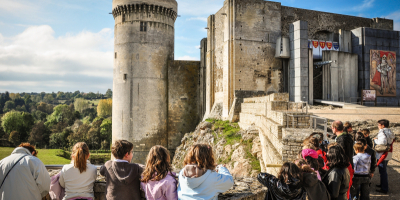
The keep of Falaise castle have known two large periods of restoration. The
first one was led by the architect Victor Ruprich-Robert, disciple of Eugène
Viollet-le-duc, in the 19th century. The second one was also led by an architect
of the “Monuments Historiques”, Bruno Decaris, in the 20th century.
A third restoration programme is under way: the restoration of the upper war
(which was ended in September 2004) and the restoration of the ramparts.
The two first interventions made on the keeps are of different natures:
The 19th century restoration:
The restoration campaign led by V. from 1864
to 1911 has several objectives. The keeps are in a state of ruin and need first
to be preserved from further decay.
Indeed, the eastern façade of the Great Keep has partly fallen down,
the vaults of the chapel are destroyed, the roofs and floors of the two square
keeps have disappeared, the are very damaged, the top of
the Talbot tower threatens to collapse… In order to preserve what remained,
Ruprich-Robert undertakes the heavy work of clearing away the rubble of collapsed
roofs
and floors, and restoring the remaining parts of the structure. He also builds
stone galleries along the walls at first floor level of the square keeps with
the aim of .
The work is considerable and will stretch over several decades but, due to lack
of finances, he cannot carry out all the restoration work. However, he saves
the keeps and makes them accessible to visitors.
The time and the Second World War heavily damage the monument again and, when
a new campaign of restoration is planned in the beginning of the 1980s, the
castle walls are in a sorry state.
Ruprich-Robert and his team reinforces the Great
Keep supporting lower part of the wall.
In the 19th, the keeps are in ruin (engraving
by Olliason)
The 20th century restoration:
Supported by the Ministry of Culture, the second programme of works, launched
in 1986, lasted ten years. The town council of Falaise -owner of the place-
is in charge of the project and, Bruno Decaris, chief architect of the “Monuments
Historiques” leads the work.
The context linked to the renovation is different to that of a century ago;
The general state of the keeps calls for a new restoration, but this time, the
aim is to return as much of their identity as possible to the buildings by restoring
their original functions, so that the visitors can understand them.The programme
is ambitious, as it has to bring the castle (which holds one of the rare surviving
examples of Anglo-Norman architecture in France) out of oblivion and to make
it attractive to the public. In accordance with the Venice Charter proposed
by the UNESCO in 1965, the architectural interventions, intended to replace
the missing parts of the keeps, bring into play the use of modern techniques
and materials. First and foremost, the visitors must not confuse the ancient
architecture and the new restoration. The work is undertaken in several phases,
is restored in 1986 and 1987, is set in place in 1992 and the main work on is carried out in 1994 , the forebuilding is built during
the last year of work, in 1996. It is the most audacious element of his work.
The architect adopts the same restoration principles as previously and, considering
the few traces at his disposition, he chooses to evoke the forebuilding without
doing a “pseudo-medieval” reconstruction and by putting the accent
on the defensive function of the original edifice.
The aula after the restoration
The sustaining partition wall of the Great Keep
and the aula under restoration
The site of the Upper Ward
During the excavations in the upper ward which took place in 1996, the ditch
separating this latter from the rest of the enclosure was cleared. The excavations
conducted there allowed to rediscover its layout, along with the remains of
the curtain wall that enclosed the ward.
An important element of the constructions of the 13th century was also brought
to light:the base of the tower called “south tower” which, with
the “Poterne” Tower, still partly visible, flanked the gatehouse
built by Philippe II Auguste.
The restoration works, carried out by the current architect-in-chief of the
“Monuments historiques”, Daniel Lefèvre, are the result of
long archeological and documentary research and of a principle which is the
one globally adopted on the site:
- when possible, reconstruction of certain parts in their original state (if
the traces or the documents are sufficiently explicit).
- evocation of the missing or uncertain parts with materials or forms conspicuously
different from those used at the origin.
For instance, the real height of the south tower and the layout of the line
on which the curtain wall was attached would always be a matter of conjecture;
so, these elements are represented with drystone walls set in metal cages. In
the same way, because the original piers and shape of the ancient bridge connecting
the upper and the lower ward over the ditch are not known, it was replaced by
a suspended metal and wood footbridge. On the other hand, the original stonework
of the east counterscarp was still very legible and therefore faithfully reconstructed.
the east counterscarp is rebuilt as it was in
the Middle Ages, the south curtain wall is redrawn.
The south tower is partially rebuilt, the ancient
bridge is replaced by a suspended metal footbridge.
The restoration of the ramparts
This last phase of renovation of the castle is not the less ambitious. Its goal
is not only to restore the castle walls, but also to emphasize the defensive
image of the site. Today, the south part of the lower ward is filled with ballast
(6 meters high). It hides vestiges of medieval buildings and give a false idea
of the real height of the inner side of the south wall, of which the top part
only is visible from the enclosure. The ballast need therefore to be removed
before restoring the towers and the wall of that part of the castle.
The preliminary survey and excavations have strengthened the project. The objective
for the next six years will now be to realise this work.